
Summary:
- Research isn’t being transformed by tools alone; there’s a broader behavioral shift in where value sits and what clients need from insight partners.
- Pharma insights teams are building their own insight ecosystems: agency value increasingly comes from synthesis, interpretation, and decision support (not data access).
- AI is now the baseline: the differentiator is responsible, intentional use combined with human judgment.
- Trust, empathy, and contextual understanding are becoming core research skills as health information gets more fragmented and harder to evaluate online.
- There’s renewed value in messiness and authenticity – outputs need to reflect reality, not just a polished narrative.
- Inclusivity is moving from principle to practice – designing for participation improves data quality and commercial outcomes.
- With rarer diseases, niche audiences, and faster decisions, the real demand is clarity: prioritization, simplification, and confident next steps.
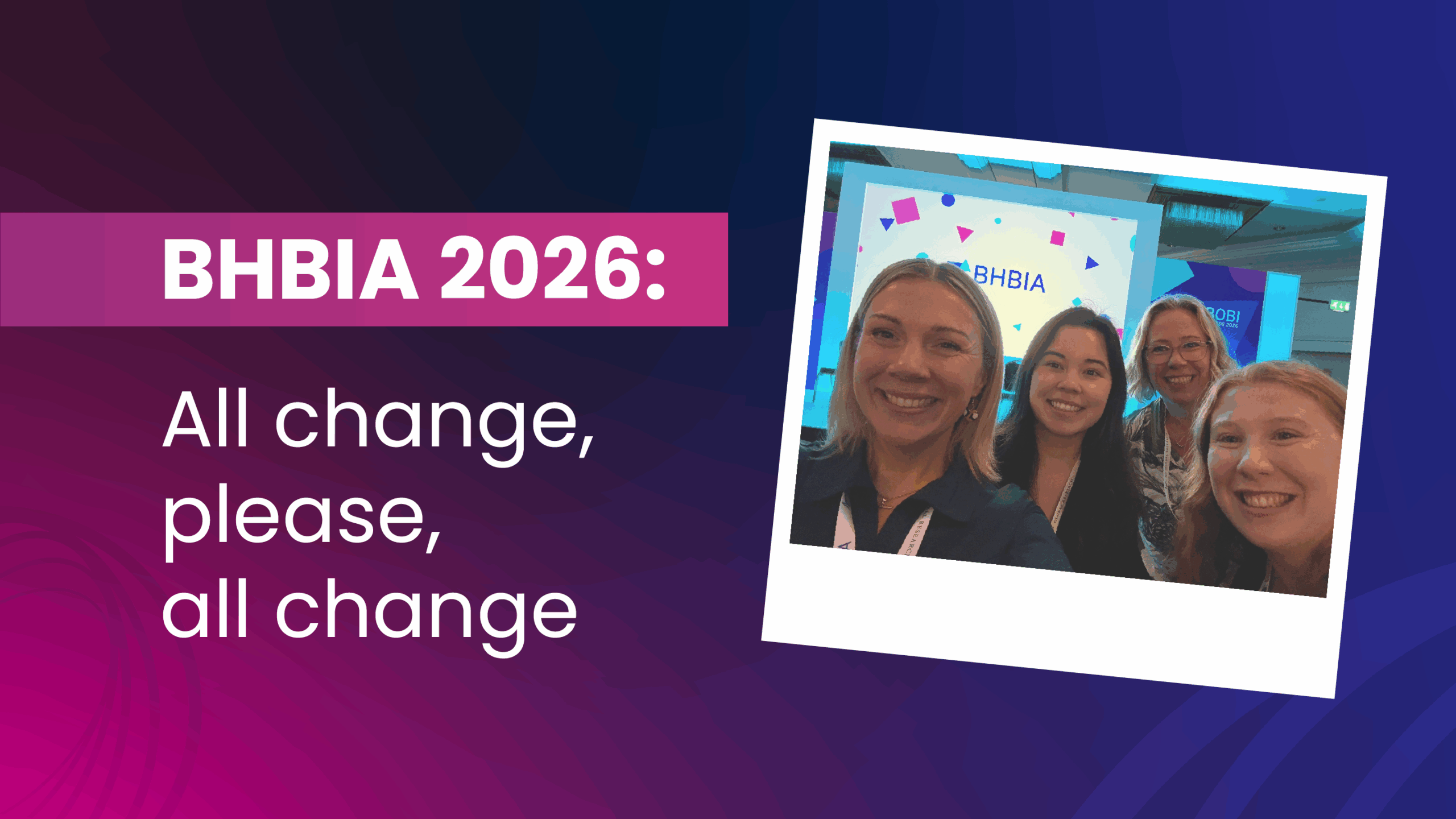
This summary is for clients and colleagues who couldn’t make it to BHBIA 2026 (and those who did, but want a quick synthesis). It captures the themes we felt kept coming up, and what they mean for how we should design, interpret, and use research in the months ahead.
Yes, AI featured heavily. But the bigger story wasn’t any single tool, but a shift in expectations: less hypothesizing and stress-testing, more pragmatic focus on where value sits now, what end-clients actually need, and what a good partnership looks like in that context.
Six themes kept resurfacing across the sessions that we joined. Taken together, they suggest something simple: the work is moving away from collecting more, and towards making better sense of what’s already there, then helping teams act on it.
1. Power shift: Pharma teams are taking back control of the data
What we heard
For a long time, agencies sat closest to the data: we collected it, analyzed it, and shaped the story. That’s no longer a given.
Pharma insights and analytics teams are building their own insight ecosystems: data lakes pooling multisource data, dashboards everywhere, and internal teams spanning data science, RWE, and advanced analytics. One UK team shared an example of managing 80+ active dashboards at a time, each supporting different brand, pathway, or performance questions.
These multisource data lakes aren’t sitting idle, they’re being queried and interrogated, often before agencies are brought into the conversation. Pharma is reclaiming ownership of its data and the questions it uses to answer. If they had a theme tune, it would be Rage Against The Machine: Take The Power Back.
What it means
Agency value can’t rely on being the data gatekeeper anymore. The value is in sense-making: connecting signals across sources, spotting what matters, and translating complexity into clear, defensible decisions.
The Beyond Blue view
- Begin engagements by mapping what data already exists (dashboards, RWE, CRM, digital), then define the few decisions that matter most.
- Bring a synthesis layer: cross-source interpretation, narrative logic, and implications, not just analysis outputs.
- Design research to complement internal analytics (filling gaps, stress-testing assumptions, and adding human context).
2. Hype down. Keep AI real.
What we heard
AI showed up in almost every session, from survey design and analysis to synthetic patients, avatars, and even a fully AI-run hospital concept. But the tone was different this year: less gimmick/debate, more practicality.
The consistent message was to use it properly. Know where it works, where it doesn’t, and where it genuinely adds value. Plan for bias, hallucinations, and limitations, and put appropriate guardrails in place for high-stakes work.
Teams aren’t waiting around – many are already building internal tools, creating agents, and embedding AI into workflows. The implication is clear: AI capability is increasingly the baseline, but how you apply it is what differentiates you.
The Beyond Blue view
Our stance at Beyond Blue is to be AI-enhanced, not AI-led: intentional use of automation where it improves speed or consistency, combined with human judgment where context, risk, and nuance matter most.
- Be explicit about where AI is used in the workflow, what it is (and isn’t) allowed to decide, and how outputs are validated.
- Use AI to accelerate synthesis (coding support, theme clustering, draft narratives) while keeping interpretation and recommendations human-led.
- Build lightweight governance: prompts, audit trails, bias checks, and escalation paths for sensitive insights.
3. The human advantage: Empathy, trust, and judgment
What we heard
One of the strongest threads was human judgment as a practical capability that shapes decisions in messy, high-stakes healthcare contexts.
Trust in health information came up repeatedly: how fragile it is, how context-dependent it is, and how increasingly fragmented it becomes when people build ‘horizontal knowledge’ across multiple online sources.
One point that stuck: as reliance on online health sources grows, we try to apply offline trust cues to online environments, but they don’t translate cleanly. For example, high engagement on social media can be mistaken for credibility or genuine connection when it may be driven by algorithms, incentives, or polarization.
Empathy and listening were reframed as core research skills rather than soft skills. There was also a strong emphasis on openness, vulnerability, and trust-building as essential to good leadership.
Behavioral science was front and center: bias, decision-making under pressure, how people process information, and how easy it is to misinterpret signals when there’s a lot coming at you. It’s worth our considering designing research that acknowledges human fallibility rather than assuming perfect rationality.
A memorable example was cognitive overload: in high-pressure situations, the first sense people can lose is hearing – they literally stop taking information in. Communication then degrades further. It’s not hard to see how often that shows up in day-to-day work, especially in complex healthcare decisions.
In our work, active listening and clear communication are non-negotiable – so we need to design studies, workshops, and outputs that help people stay cognitively ‘clear’ enough to absorb, decide, and act.
The Beyond Blue view
If AI accelerates production, the scarce capability becomes judgment: framing the right question, understanding context, spotting what’s missing, and knowing what is safe to conclude. Research that earns trust will demonstrate empathy, transparency, and methodological humility.
- Design for trust: be clear about uncertainty, triangulate sources, and show how conclusions were reached.
- Build more ‘listening time’ into qual: slower moderation where needed, better probes, and fewer assumptions.
- Create outputs that reduce overload: fewer slides, clearer decisions, and explicit trade-offs.
4. Authenticity: The Director’s cut
What we heard
A few sessions raised an uncomfortable question for our industry: in an over-curated world, are we sometimes drifting away from the ‘real’ world we claim to reflect?
We’ve become very good at producing clean, polished outputs, clear stories, neat narratives, and digestible content.
But there’s a risk that we sand down the edges: the contradictions, context, and uncertainty that make insight feel true and useful.
At the same time, AI is now part of everyday life. It shapes how people search, think, and even respond. So we are faced with a dilemma: do we try to ‘strip out’ AI influence, take out the predictability and conformity to get something more ‘pure’, or treat it as part of the reality we’re trying to understand?
There’s no perfect answer, but it does feel like there’s renewed value in work that feels real, even if imperfect. Sometimes, a spelling mistake or a messy verbatim signals genuine humanity more than a flawless narrative.
The Beyond Blue view
Authenticity isn’t about lowering our standards; it’s about representing reality accurately enough to inform decisions. That often means holding space for ambiguity, minority views, and inconvenient context, rather than forcing a single neat storyline.
- Protect the “rough edges”: include contradictions, confidence levels, and what we can’t yet conclude.
- Use AI thoughtfully in qual (e.g., to assist analysis) without smoothing away nuance or voice.
- Bring our clients closer to reality via richer evidence (audio clips, longer verbatims, immersion moments) where appropriate.
5. Putting a commercial value on inclusivity
What we heard
Inclusive research has been discussed for a while, but this year it felt more tangible: less about why it matters and more about how to do it. Practical examples included simplifying language, designing for different literacy levels, making participation easier, and offering more flexible ways to take part. Small, but meaningful changes. We already have the technology and skills to make these adaptations, we just need to be brave enough to challenge ‘what we’ve always done’.
Put simply, we should design research around people and not expect people to fit our processes. Meeting participants where they are is often the only way to understand real experience. We also need to articulate the commercial value: inclusivity improves representativeness, reduces hidden bias, and leads to better decisions. It isn’t just ethical; it improves data quality and business outcomes.
As audiences get more fragmented and harder to reach, that feels increasingly important. As someone said to me in a workshop session, “I don’t like that phrase ‘hard to reach’, it feels so defiant; if you’re determined enough, you will find them”.
The Beyond Blue view
As audiences fragment and recruitment becomes harder, ‘inclusive by design’ is a competitive advantage. The organizations that adapt research experiences to participants will access richer, more reliable insight, and reduce the risk of building strategy on unrepresentative samples.
- Challenge inclusion into the brief: who is missing, what barriers exist, and what adaptations are needed (language, format, timing, accessibility).
- Offer mixed-mode participation options (where suitable) to reduce burden and widen reach.
- Report inclusivity as a quality metric: what changed, who it enabled, and the impact on confidence in decisions.
6. Niche and complex
What we heard
Across all themes sat a steady increase in complexity: more rare diseases, more niche populations, more challenging recruitment and higher screen-out rates, plus a more complex NHS and Payer landscape that pharma must navigate for messaging to land effectively.
At the same time, organizations are flatter, decisions are faster, and the volume of available data keeps rising.
The challenge isn’t a lack of information, it’s interpretation. Teams need help separating signal from noise, understanding what the data can (and can’t) say, and aligning on priorities when the road ahead isn’t fully clear.
Which is why the need isn’t really for more data, as always, it’s for clarity. For helping people prioritize, simplify, and move forward with confidence.
The Beyond Blue view
In complex categories, ‘good’ research is increasingly defined by decision usefulness: how quickly it helps teams choose a direction, what trade-offs it clarifies, and how confidently it can be acted on.
- Design studies around decisions (not outputs): define the decision, the uncertainties, and the minimum evidence needed to move.
- Use recruitment and screen-outs as insight: what’s driving non-participation, and how can we adapt?
- Deliver clearer recommendations: prioritized options, risks, and next-best actions rather than exhaustive reporting.
So where does that leave us?
Stepping back, this didn’t feel like a conference about one single breakthrough. It felt more like a rebalancing.
Less emphasis on collecting more or building more tools. More emphasis on interpreting, connecting, and acting on what’s already there.
Less about delivering answers, more about helping people make better decisions – faster, and with more confidence.
For agencies and insight partners, that’s a clear prompt: bring clarity, not clutter.
Bring judgment and be brave to challenge. And naturally, help teams turn complex evidence into action.
If you’d like to discuss what these themes mean for your portfolio or an upcoming project, we’d love to compare notes – get in touch today.